Featured
Storage
Benchmark
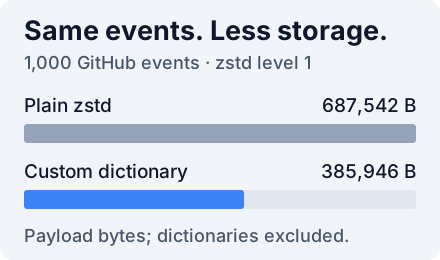
Reduce Storage by 43.9% with a Custom Zstd Dictionary
Train on real GitHub events and measure storage savings, dictionary overhead, and S3 read performance.
Engineering, benchmarks, and practical guides.
Train on real GitHub events and measure storage savings, dictionary overhead, and S3 read performance.
17 articles
Train on real GitHub events and measure storage savings, dictionary overhead, and S3 read performance.
Compare S3 reads over RDMA and HTTP with measured throughput and byte-for-byte verification.
Run the same SQL against one table bucket using Trino and DuckDB, with measured timings.
Give inference fleets a shared, persistent LMCache L2 with direct RDMA access and restart guarantees.
Build an analytics warehouse with storage tiers, erasure coding, stateless gateways, and monitoring.
Keep hot table metadata on SSD while aging cold data into erasure coding and cloud storage.
Configure and watch continuous replication between two real SeaweedFS clusters from the Admin UI.
Host Git repositories with an S3 bucket as durable storage, then add a local cache in front of cloud S3.
Combine Iceberg analytics and Lance vector serving in one object store, joined through DuckDB.
Write embeddings, build an index, and run vector searches with every file stored in SeaweedFS.
Read and write Iceberg tables from ClickHouse through the built-in SeaweedFS REST catalog.
Create a table bucket, load data, and query it directly from DuckDB without an external catalog service.
How SeaweedFS makes S3 conditional writes atomic across gateways and different metadata backends.
Keep most of the metadata savings of sealed directories while accepting occasional writes and updates.
Install the SeaweedFS kernel filesystem on Debian, mount it, run real applications, and export it over NFS.
Restore deleted files or rewind a subtree to an earlier point in time, with a preview before recovery.
Pack cold directory metadata into compressed segments while keeping every file readable in place.
Try another keyword or choose a different topic.